
Last Updated on October 19, 2026
Cooking with the right cookware set is important for preparing delicious, evenly cooked meals. If you are looking for durable cookware and are stuck between All-Clad cookware and Cuisinart cookware, you have come to the right place.
All-Clad and Cuisinart are two popular cookware brands with several collections to choose from. Both offer stainless steel, nonstick, and specialty cookware for different cooking needs. However, their construction, manufacturing locations, performance, and prices vary considerably.
Do you want a premium stainless steel cookware set that can last for many years, or an affordable set that provides good everyday cooking performance?
In this updated All-Clad vs. Cuisinart cookware comparison for 2026, we will discuss the differences between these two brands to help you make the right decision.
All-Clad vs. Cuisinart Cookware: Quick Comparison Table
| Features | All-Clad | Cuisinart |
|---|---|---|
| Made In | USA for major bonded stainless steel collections; China for selected nonstick collections | Primarily China; varies by collection |
| Materials | Stainless steel, aluminum, copper, nonstick coatings | Stainless steel, aluminum, copper, hard-anodized aluminum, nonstick coatings |
| Construction | Fully clad 3-ply and 5-ply options; hard-anodized nonstick | Impact-bonded and fully clad options; hard-anodized nonstick |
| Durability | Excellent in premium stainless steel collections | Good to excellent, depending on collection |
| Heat Distribution | Excellent in fully clad models | Very good in MultiClad Pro and other fully clad models |
| Oven Safe | Up to 600°F for selected stainless steel collections | Up to 500°F for MultiClad Pro stainless steel |
| Dishwasher Safe | Selected collections; hand washing recommended for bonded stainless steel | Many collections, including MultiClad Pro |
| Induction Compatible | Most current stainless steel collections and selected nonstick models | MultiClad Pro and selected other collections |
| Cost | Midrange to premium | Budget to premium |
| Price |  Check Price |
 Check Price |
In this All-Clad vs. Cuisinart cookware comparison, we will look at their origins, construction, materials, durability, design, cooking performance, and prices.
What Are the Similarities?
Although All-Clad and Cuisinart compete at different price points, they share several features.
Both brands offer stainless steel cookware with aluminum cores that help distribute heat evenly. They also produce nonstick pans, although the coatings and construction methods vary by collection.
Another similarity is their wide selection of cookware. You can purchase individual frying pans, saucepans, stockpots, and complete sets from either brand.
Both manufacturers offer warranty coverage on many cookware products. However, warranty terms vary, and normal wear or damage caused by misuse is generally excluded.
For cleaning, many Cuisinart cookware sets are dishwasher-safe, while All-Clad recommends hand washing its bonded stainless steel collections to maintain their appearance.
So, both brands offer quality cookware, but the differences become clearer when comparing individual collections.
Features Comparison: All-Clad vs. Cuisinart Cookware
Difference 1: Status and Origin
All-Clad and Cuisinart are established cookware brands with American roots.
All-Clad was founded in 1971 by metallurgist John Ulam. The brand became known for developing bonded metal cookware that combines stainless steel with highly conductive materials such as aluminum and copper.
Cuisinart was established in 1971 and became popular after introducing its food processor to the American market in 1973. The company later expanded into cookware, appliances, and other kitchen products.
The biggest difference is their manufacturing approach. All-Clad’s major bonded stainless steel cookware collections are manufactured in Canonsburg, Pennsylvania, using global components.
However, not every All-Clad product is made in the USA. Its HA1 hard-anodized nonstick cookware, for example, is manufactured in China.
Cuisinart cookware is also manufactured in different countries, with many popular sets made in China.
Related article: All-Clad vs. Demeyere cookware comparison.
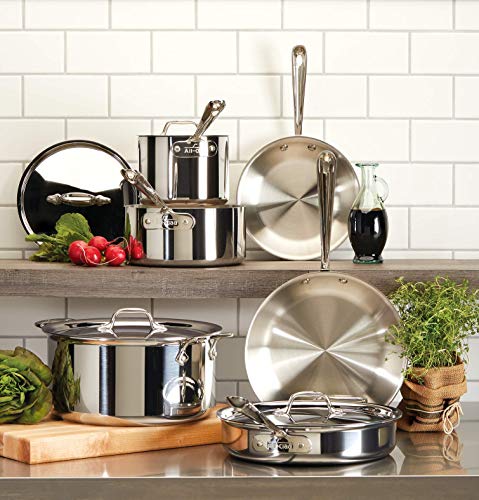 Check Price On Amazon
All-Clad generally targets buyers looking for premium construction and long-term performance. Cuisinart offers more affordable options alongside fully clad stainless steel cookware.
If you are comparing other established cookware brands, our Calphalon cookware review provides another option worth considering.
Difference 2: Construction
Cookware construction is one of the most important factors affecting heating performance.
Copper and aluminum conduct heat much more efficiently than stainless steel. Manufacturers often combine these materials to create cookware that is both durable and responsive to temperature changes.
All-Clad is particularly known for fully clad construction. In collections such as D3 and D5, the bonded metal layers extend from the bottom of the pan up its sidewalls.
Cuisinart uses different construction methods. Its Chef’s Classic Stainless Steel collection has an aluminum-encapsulated base, while MultiClad Pro features fully clad triple-ply construction.
Therefore, it is not accurate to say that all Cuisinart cookware has aluminum only in the base. The difference depends on which collections you compare.
Other brands, such as Farberware and Rachael Ray, also offer cookware with different aluminum and stainless steel constructions.
Difference 3: Materials
Both All-Clad and Cuisinart use stainless steel, aluminum, and nonstick coatings across their cookware collections.
All-Clad D3 cookware uses three bonded layers, including an aluminum core between stainless steel surfaces.
Its D5 collection features five-ply construction, while Copper Core cookware includes copper alongside aluminum and stainless steel.
Cuisinart MultiClad Pro uses a three-layer design with an aluminum core between stainless steel layers.
One important distinction is that not every All-Clad cookware collection contains copper. Copper is featured in selected premium models, while aluminum remains the main conductive material in popular collections such as D3.
 Check Price
Both brands also offer nonstick cookware. All-Clad HA1 uses PTFE-based nonstick coating, while selected Cuisinart collections use traditional or ceramic nonstick surfaces.
The best material depends on whether you prioritize durability, nonstick convenience, heat responsiveness, or easy maintenance.
Difference 4: Durability
If you want cookware that lasts for many years, All-Clad is an excellent choice. Its bonded stainless steel collections are designed for long-term cooking performance.
All-Clad D3, D5, and Copper Core cookware feature sturdy construction and can withstand regular stovetop and oven use when properly maintained.
However, Cuisinart is not necessarily less durable. Its MultiClad Pro stainless steel collection also features fully clad construction and can provide many years of reliable service.
The biggest difference is often the thickness, design, and finishing of the particular cookware model rather than the brand name alone.
Stainless steel cookware generally lasts longer than nonstick cookware because it does not depend on a coating that gradually wears away.
Both brands offer lifetime warranty coverage on selected products, although warranty terms and exclusions differ.
Difference 5: Design
Both All-Clad and Cuisinart manufacture attractive cookware that complements modern kitchens.
All-Clad D3 and Cuisinart MultiClad Pro have similar designs, including stainless steel cooking surfaces, flared rims, and riveted handles.
All-Clad D3 typically features a polished stainless steel exterior, while Cuisinart MultiClad Pro has a brushed stainless steel finish.
The handles also differ. All-Clad’s traditional stainless steel handles have a distinctive grooved shape, while Cuisinart’s Cool Grip handles have a more rounded design.
Some home cooks prefer Cuisinart’s handles, while others appreciate All-Clad’s secure grip.
Both collections come with stainless steel lids, unlike many Granite Rock nonstick pans that feature different lid and coating designs.
Difference 6: Cooking Performance
When it comes to everyday cooking, both brands perform well.
All-Clad and Cuisinart stainless steel cookware can handle searing, sautéing, simmering, boiling, and braising.
Both use conductive aluminum cores to spread heat and stainless steel cooking surfaces that resist reactions with acidic ingredients.
However, cooking performance also depends on the cookware’s thickness and construction.
For instance, a fully clad All-Clad D3 pan and a Cuisinart MultiClad Pro pan may deliver similar results in many everyday recipes.
Premium All-Clad collections may offer different temperature responsiveness and heat retention, but that does not automatically mean every meal will turn out better.
Difference 7: Conductive Materials
All-Clad offers different bonded metal constructions depending on the cookware collection.
D3 uses three layers with an aluminum core. D5 features five layers, while Copper Core combines stainless steel, aluminum, and copper.
Copper is highly responsive to temperature changes, making it useful for cooking methods that require careful heat control.
Cuisinart MultiClad Pro uses an aluminum core extending through the cookware’s bottom and sidewalls.
Both aluminum and copper are effective heat conductors. The number of layers alone does not determine cookware performance. Material thickness and overall construction are also important.
Difference 8: Heat Distribution
All-Clad is known for even heat distribution, especially in its fully clad cookware collections.
The aluminum or copper layers help spread heat across the cooking surface and up the sidewalls.
However, Cuisinart MultiClad Pro uses a similar fully clad design with an aluminum core throughout the pan.
Therefore, both brands can distribute heat evenly when comparing equivalent fully clad cookware.
Some Cuisinart models, such as Chef’s Classic Stainless Steel, have an aluminum-encapsulated base instead. These pans can still provide good cooking performance, although their sidewalls may heat differently.
Related article: T-Fal vs. Cuisinart: Comparing cookware performance and features.
Difference 9: Oven-Safe Temperature
Oven safety is another important factor when comparing All-Clad vs. Cuisinart cookware.
All-Clad D3, D5, and Copper Core stainless steel cookware are oven- and broiler-safe up to 600°F.
Cuisinart MultiClad Pro stainless steel cookware is oven-safe up to 500°F.
For nonstick cookware, the limits are different. All-Clad HA1 Expert Nonstick pans are oven-safe up to 500°F, but their glass lids are rated up to 350°F.
Cuisinart nonstick cookware has model-specific temperature limits. Some models support 350°F, while selected newer collections allow higher temperatures.
Always follow the lowest applicable temperature limit for the pan, handle, or lid.
Difference 10: Dishwasher Safety
Both brands offer dishwasher-safe cookware, but not every collection has the same cleaning requirements.
Cuisinart MultiClad Pro is dishwasher-safe, making everyday cleaning convenient.
All-Clad recommends hand washing its bonded stainless steel collections to help maintain their appearance and finish.
All-Clad HA1 Expert Nonstick cookware is dishwasher-safe, although gentle hand washing is recommended to preserve the nonstick coating.
For either brand, avoid harsh abrasive cleaners and allow hot cookware to cool before washing.
Difference 11: Induction Compatibility
Induction compatibility depends on whether the cookware has a suitable magnetic base.
All-Clad D3, D5, Copper Core, and many HA1 nonstick pans support induction cooking.
Cuisinart also produces induction-compatible cookware, including MultiClad Pro and selected Chef’s Classic Stainless Steel models.
However, some aluminum nonstick collections from either brand do not work on induction cooktops.
Before purchasing cookware for an induction stove, check the exact model specifications. You can also test whether a magnet sticks firmly to the bottom of the pan.
Popular Cookware Collections from All-Clad and Cuisinart
Both brands offer several cookware collections for different budgets and cooking styles. Here are some popular options worth considering in 2026.
Popular All-Clad Cookware Collections
- All-Clad D3 Stainless: Three-ply bonded stainless steel cookware designed for everyday cooking.
- All-Clad D3 Everyday: A variation of the D3 collection with redesigned handles and cooking features.
- All-Clad D5 Stainless: Five-ply bonded cookware designed for steady, controlled heating.
- All-Clad Copper Core: Premium five-ply cookware featuring a copper core for responsive heat control.
- All-Clad HA1 Expert Nonstick: Hard-anodized aluminum cookware with PTFE nonstick coating.
- All-Clad Ceramic Nonstick: Selected collections featuring ceramic nonstick coatings for buyers who prefer PTFE-free cooking surfaces.
Popular Cuisinart Cookware Collections
- Cuisinart MultiClad Pro: Triple-ply stainless steel cookware with an aluminum core.
- Cuisinart Chef’s Classic Stainless Steel: Stainless steel cookware with an aluminum-encapsulated base.
- Cuisinart Professional Series: Stainless steel cookware designed for everyday cooking.
- Cuisinart Chef’s Classic Nonstick: Hard-anodized cookware with nonstick cooking surfaces.
- Cuisinart Advantage Nonstick: Affordable nonstick cookware for regular home use.
- Cuisinart PURELYCERAMIC: Selected ceramic nonstick cookware made without intentionally added PFAS.
If you are specifically interested in nonstick cookware, check our ceramic cookware buying guide for additional options.
All-Clad vs. Cuisinart: Price Difference
One of the biggest differences between All-Clad and Cuisinart cookware is the price.
All-Clad generally costs more, particularly in its bonded stainless steel collections.
Its D3 and D5 cookware sets are priced higher than many Cuisinart alternatives. The Copper Core collection is even more expensive because of its materials and construction.
Cuisinart MultiClad Pro provides fully clad stainless steel performance at a more accessible price.
However, prices change depending on the cookware size, included pieces, retailer, and available discounts.
Premium copper-containing cookware from other brands, including Lagostina, can also cost considerably more than standard stainless steel sets.
For shoppers on a budget, Cuisinart generally offers better value. If you are willing to pay more for premium construction and American-made bonded stainless steel cookware, All-Clad is worth considering.
When Cuisinart Wins Over All-Clad
Cuisinart is a strong choice for buyers who want dependable cookware without spending too much.
The brand offers a variety of designs, materials, and set sizes. Its MultiClad Pro collection is particularly appealing because it provides fully clad construction at a competitive price.
Cuisinart also offers affordable nonstick cookware for people who prefer quick cooking and easy cleaning.
For budget-conscious buyers, Cuisinart is often the better choice. You can get durable cookware suitable for everyday meals without paying premium prices.
When All-Clad Wins Over Cuisinart
All-Clad is an excellent option for buyers who want premium cookware construction.
Its D3, D5, and Copper Core collections are designed for consistent heating and long-term durability.
Many of its popular bonded stainless steel products are manufactured in the USA, which may appeal to buyers who prioritize American-made cookware.
All-Clad also offers a higher oven-temperature limit on several stainless steel collections.
However, you do not necessarily need premium cookware to prepare excellent meals. Cuisinart’s fully clad products can deliver comparable everyday cooking results for many home cooks.
Which Is Better: All-Clad or Cuisinart Cookware?
After comparing All-Clad vs. Cuisinart cookware, both brands have clear advantages.
If you want affordable stainless steel or nonstick cookware, Cuisinart is an excellent choice. Its MultiClad Pro collection provides fully clad construction, induction compatibility, and good cooking performance at a generally lower price.
If you want premium stainless steel cookware with excellent durability, high oven-temperature limits, and American-made bonded construction, All-Clad is worth the additional investment.
For nonstick cookware, evaluate the specific coating rather than relying on the brand name. Traditional PTFE and ceramic nonstick surfaces have different characteristics and care requirements.
Related topic: All-Clad vs. Calphalon: Which cookware should you buy?
Overall, I would choose All-Clad for premium stainless steel cookware and Cuisinart for value. Both can serve your kitchen well when you select the right collection for your cooking habits.
FAQs
Which brand offers better durability, All-Clad or Cuisinart?
All-Clad is known for durable bonded stainless steel cookware. However, Cuisinart MultiClad Pro is also well constructed and can last for many years when properly maintained.
Are All-Clad pans worth the higher price compared to Cuisinart?
All-Clad pans can be worth the higher price if you want premium construction, high oven-temperature limits, and American-made bonded stainless steel cookware. For everyday cooking on a budget, Cuisinart provides excellent value.
Which brand is better for beginner cooks, All-Clad or Cuisinart?
Cuisinart is generally more beginner-friendly because it offers many affordable cookware sets. However, both brands have products suitable for beginners and experienced cooks.
Do All-Clad and Cuisinart cookware work on induction stoves?
Yes, both brands offer induction-compatible cookware. All-Clad D3, D5, and Copper Core support induction cooking, as does Cuisinart MultiClad Pro. Check the specifications for other collections.
Which brand offers better nonstick cookware, All-Clad or Cuisinart?
Both brands offer reliable nonstick cookware. All-Clad HA1 features hard-anodized aluminum and PTFE coating, while Cuisinart offers both traditional and ceramic nonstick options. The best choice depends on your budget, preferred coating, and cooking needs.
Is All-Clad cookware made in the USA?
Many All-Clad bonded stainless steel cookware collections, including D3 and D5, are manufactured in Canonsburg, Pennsylvania, using global components. However, selected products, including HA1 Expert Nonstick, are made in China.
Is Cuisinart MultiClad Pro fully clad?
Yes. Cuisinart MultiClad Pro uses triple-ply construction with an aluminum core extending through the cookware’s base and sidewalls. This helps distribute heat evenly during cooking.
Can All-Clad and Cuisinart cookware go in the dishwasher?
Cuisinart MultiClad Pro is dishwasher-safe. All-Clad recommends hand washing its bonded stainless steel cookware, although selected nonstick collections are dishwasher-safe. Always follow the cleaning instructions for your specific model.