
Last Updated on November 4, 2026
Modern cookware offers plenty of choice, but coating labels can make shopping confusing. Questions about PFOA in cookware often mix up a manufacturing chemical, a nonstick coating and a much larger family of substances. They are related, but they are not interchangeable.
PFOA is perfluorooctanoic acid, a PFAS chemical formerly used as a processing aid in making some nonstick coatings. It is not the coating itself. Many modern pans are labeled PFOA-free while still using PTFE, the material in traditional nonstick surfaces. Here is what those differences mean, what the health evidence says and how to compare alternatives.
What is PFOA in cookware?
PFOA is a manufactured, nonpolymeric chemical in the PFAS family. Historically, it helped in the production of fluoropolymers used for some nonstick coatings. It was not the ingredient that, by itself, made a finished pan scratch-proof or nonstick. PTFE is the polymer that provides the familiar easy-release cooking surface.
PFOA and related PFAS have also been used in industrial processes and products such as surface treatments, textiles, paper and firefighting foams. Their persistence in the environment and the body is a major reason for concern. Its manufacturing history is different from the materials in the particular pan you own.
Core differences between PFOA and PTFE
PTFE stands for polytetrafluoroethylene. It is a large fluoropolymer with low chemical reactivity under intended conditions. PFOA is a much smaller chemical and is not PTFE. Both belong to the broad PFAS family, but their properties, uses and exposure pathways differ.
| Cookware term | Meaning | What to check |
|---|---|---|
| PFOA | Perfluorooctanoic acid; historically used as a processing aid | Not the finished nonstick coating |
| PTFE | A fluoropolymer used for traditional nonstick surfaces | Can be present in PFOA-free cookware |
| PFAS | A broad family that includes PFOA and PTFE | PFOA-free does not mean free of all PFAS |
| PFOA-free | A claim about one particular chemical | Does not establish PTFE-free or PFAS-free status |
| PFAS-free | A broader material claim | Check the manufacturer’s definition, disclosures and supporting information |
Why is PFOA dangerous for health?
PFOA persists for a long time, and exposure has been associated with several health effects. These findings do not mean that using any nonstick pan causes these illnesses. Risk depends on the amount, duration and route of exposure, as well as individual factors.
Drinking contaminated water, eating contaminated food and some workplace exposures are important routes. The FDA describes migration from authorized, properly manufactured polymerized nonstick coatings as negligible. This differs from exposure to PFOA pollution and from fumes caused by severely overheating a PTFE-coated pan.

Liver damage
Studies have associated exposure to PFOA and some other PFAS with changes in liver enzymes. That finding is different from saying a pan will cause liver failure or a liver tumor. The evidence does not support the idea that every damaged nonstick surface releases PFOA into a meal.
Thyroid disease
The thyroid evidence is less consistent. ATSDR did not find consistent evidence of an association with thyroid disease or dysfunction in its review, while the National Academies categorized the evidence for PFAS as limited or suggestive. It is inaccurate to present acute thyroid disease as an inevitable effect of PFOA.
Testicular and kidney cancer
In December 2023, the International Agency for Research on Cancer classified PFOA as carcinogenic to humans, Group 1. Its evaluation drew on animal and mechanistic evidence, with limited evidence in humans for kidney and testicular cancer. This is a cancer-hazard classification, not a calculation of the cancer risk from a particular pan or meal.
Reproductive complications
Research has associated PFOA exposure with small decreases in birth weight and, along with PFOS, pregnancy-induced hypertension or preeclampsia. These findings do not mean all exposed people will have pregnancy complications, or that normal cookware use establishes the source of an individual’s exposure.
High cholesterol and high blood pressure
Higher cholesterol levels are among the health effects associated with exposure to certain PFAS, including PFOA. The blood-pressure association highlighted by ATSDR concerns pregnancy-induced hypertension and preeclampsia. It should not be described as a direct sequence in which a nonstick pan blocks the heart or causes general hypertension.
Immune response
Another concern is an association between some PFAS, including PFOA, and reduced antibody responses to certain vaccines. Health evidence concerns exposure to specific substances and levels; it should not be generalized into a claim that every PFAS behaves identically.
Is PFOA Still Used in Cookware?
PFOA has been phased out of production by major manufacturers, but there was no universal worldwide cookware ban in 2003. The U.S. EPA launched its PFOA Stewardship Program in 2006. Eight participating companies committed to reductions and to working toward elimination from emissions and product content by 2015; EPA reports that the participants met the program’s goals.
Other restrictions and phaseouts vary by country. Historical production and environmental contamination remain relevant because PFOA does not readily break down. For buyers concerned about PFOA in cookware, a product’s current material disclosure is more useful than assuming every pan of a certain age, country or brand has the same coating.
The FDA’s 2024 announcement about the end of U.S. sales of PFAS grease-proofing agents for paper food packaging concerned packaging, not a blanket ban on every PTFE-coated frying pan. PFOA phaseouts, food-packaging changes and broader PFAS restrictions are different developments.
What are the alternatives to PFOA in Cookware?
If your aim is to avoid fluorinated nonstick coatings, compare the cooking surface rather than the PFOA-free label alone. Uncoated metals and suitably specified ceramic products offer different trade-offs. None is scratch-proof, damage-proof or automatically suitable for every heat source.
Ceramic Cookware
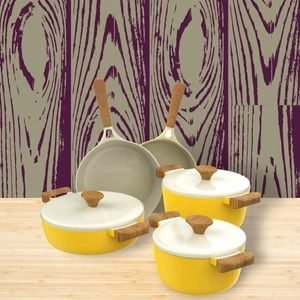
Many ceramic cookware products have a metal body with a ceramic nonstick coating; others are solid ceramic. Check the maker’s PFAS and PTFE disclosures. Coated pans often provide easy release but need gentle utensils and controlled heat. Heating performance depends on the body and base, not just the ceramic label.
Our ceramic and stainless steel buying guide explains the differences between coated pans, solid ceramic vessels and uncoated stainless steel.
Cast iron pans and pots

Bare seasoned Cast iron pans and pots do not need a factory-applied fluoropolymer nonstick coating. They retain heat well and suit browning, but are heavy and need drying and seasoning care. Enameled cast iron has a different surface. Follow the individual pan, handle and lid limits rather than assuming one oven temperature covers every piece.
Stainless steel set
Uncoated stainless steel is a durable alternative without a nonstick coating to wear away. An aluminum or copper core helps distribute heat. It can still scratch, discolor or warp, so proper care matters. Frying takes more attention than in nonstick, while boiling and simmering do not require extra oil.
Stoneware cooking set

Food-contact-rated ceramic stoneware can be useful for baking and serving, but check the glaze and intended use. Most ordinary stoneware baking dishes are not for a stovetop or direct flame. Avoid sudden temperature changes. A metal pan marketed with a “stone” or “granite” finish may still have a nonstick coating, so read its material description.
How do you avoid PFOA to minimize health risks?
Addressing concerns about PFOA in cookware starts with accurate coating information. Good pan care also reduces overheating and surface damage, although these steps do not remove PFOA already present in drinking water or the environment.
- Stop preheating the empty pan: Do not leave a nonstick pan empty on a hot burner. Follow its instructions for adding food, oil or liquid and stay nearby while cooking.
- Using low temperature: Low to medium heat is usually recommended for nonstick cooking. Use uncoated cookware for intense searing and follow the exact pan, handle and lid ratings for oven use. Ventilate the kitchen.
- Avoid using metal utensils: Wood or silicone tools are gentle choices for coated surfaces. Avoid cutting in the pan and use nonabrasive cleaning methods unless the manufacturer specifically permits otherwise.
- Check the condition: Replace coated cookware when it is peeling, flaking or excessively scratched. A scratch by itself does not identify the coating’s chemistry or prove PFOA exposure.
- Look beyond the pan: If local authorities identify PFAS in drinking water or locally caught fish, follow their guidance. Where water treatment is needed, choose a system independently certified for the relevant PFAS reduction and maintain it as instructed.
Alternatives: PFOA-Free Cookware List
When comparing safe cookware brands, evaluate the specific collection. A single company may sell uncoated stainless steel, PTFE nonstick and ceramic nonstick. PFOA-free is one material claim, not a guarantee that every product from the brand is PFAS-free or suitable for every cooking method.
All-Clad cookware

All-Clad offers uncoated stainless steel, traditional nonstick and ceramic nonstick collections. Its chemical disclosure states that PTFE-coated products contain PFAS. Therefore, it is incorrect to describe all All-Clad cookware as PTFE-free. Coating construction and care vary by collection; do not apply one coating-layer count or oven rating to the entire brand.
Calphalon Pots and Pans

Calphalon cookware has a history dating to 1963 and includes different cooking surfaces. Its material disclosures identify PTFE in traditional nonstick cookware and list ceramic and stainless collections separately. A PFOA-free Calphalon nonstick pan is not necessarily PTFE-free. Check the exact collection’s materials, utensils, dishwasher instructions and temperature limits.
Final Words
Understanding PFOA in cookware is easier when you separate PFOA, PTFE and PFAS. Choose by the actual cooking surface, compare the manufacturer’s disclosures and use the cookware within its limits. If you want to avoid fluorinated coatings, consider uncoated stainless steel or cast iron, or a ceramic product with clear supporting material information.
Our stainless steel versus nonstick comparison can help you match a pan to your cooking habits. The useful goal is informed shopping and sensible care, rather than treating a single “free-from” label as a complete safety assessment.