
Last Updated on November 11, 2026
Thinking about switching to induction? Before you buy a new set, turn over the pans you already own. A cast-iron skillet or a stainless steel pot with a magnetic base may work just fine. The quick checks below will help you see which pieces you can keep and where a replacement might be worth it.
What Is Induction Cookware?
Induction cookware is a pot or pan with a base that can heat on an induction cooktop. A coil beneath the glass creates a changing magnetic field, which induces electric currents in the base. The base heats up and passes that heat to the food. The hot pan can warm the glass underneath it, so let the surface cool before touching or cleaning it.
How to Tell if a Pan Is Induction-Ready
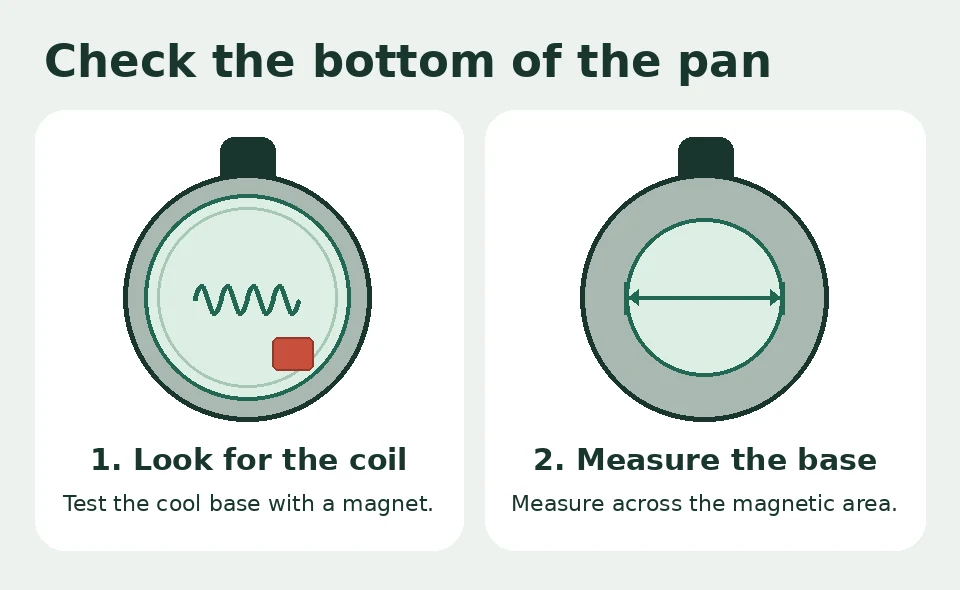
Look at the base and packaging. The underside may have a small coiled-spring symbol. The box or the product page may say “induction-ready” or “induction-compatible.” If the mark is missing, check the exact model or use the magnet test. Whirlpool’s guide shows what the coil symbol looks like.
Try a magnet on the cool underside. A magnet that sticks firmly across much of the bottom is a good sign. Check more than one spot if the base has a separate disk. A weak grip or a very small magnetic patch may mean uneven heating or that your cooktop cannot detect the pan. A magnet sticking to the side or handle tells you little about the cooking base.
This video walks through how to check cookware you already have.
Why Pan Size, Flatness, and Position Matter
Measure across the flat, magnetic part of the underside. A skillet sold as 11 inches is typically measured at the rim and may have a much smaller magnetic base. Compare your measurement with the minimum pan size for the zone in your cooktop manual. The minimum can differ from one zone or appliance model to the next. See GE Appliances’ guide to pan size and shape.
Set the pan on a clean, level surface to see if it rocks, then center it on the closest-size cooking zone. A warped or rounded base can heat unevenly. A pan that extends far beyond the zone may also cook more slowly around the edges.
If the zone flashes or won’t heat, center the pan again and try a smaller zone that matches the base. Then try a known-compatible flat pan to see whether the problem follows the cookware. On the models covered by this Bosch induction cooktop manual, an unsuitable pan can make the zone display flash before it switches itself off. Check your own manual for the meaning of the indicator. Use a little water to confirm heating and avoid running a dry pan on high.
Which Materials Work on Induction?
Before buying the cookware, start with the base. A pan can have an aluminum core, a ceramic cooking surface, or a copper exterior and still work if it has a suitable magnetic bottom.
| Material | Works on induction? | What to check |
|---|---|---|
| Cast iron, enameled cast iron, and most carbon steel | Usually yes | Choose a flat, stable base that fits the zone. |
| Stainless steel | Depends on the model | Look for a magnetic outer layer. A stainless cooking surface alone tells you little about the base. |
| Aluminum or copper | Only with a suitable magnetic base on standard induction | Look for an induction-rated bonded base, then measure its magnetic area. |
| Ceramic-coated or PTFE nonstick | Depends on the base | Either coating can be used on a pan with an induction-ready base. Check the exact model. |
| Plain glass or solid ceramic | Generally no on standard induction | Check the cookware instructions for approved heat sources. |
Stainless Steel

Bonded stainless cookware often uses an aluminum or copper core to spread heat and a magnetic stainless exterior to work on induction. Cladding describes the layers bonded together. Check what the outside layer is made of. If you’re comparing Great Jones pots and pans, look up each piece’s stovetop compatibility.
Cast Iron and Enameled Cast Iron

A flat-bottomed cast-iron skillet is a good piece to test first. Enameled cast iron generally works too because the iron underneath the enamel is magnetic. The enamel is a glass-like finish. Lift heavy pieces when moving them across a glass cooktop. If you’re considering Stargazer Cookware, check the base diameter against the burner you plan to use.
Aluminum and Ceramic-Coated Pans

Plain aluminum is light and spreads heat well, but standard induction needs a magnetic layer. The GreenPan Valencia Pro 10-inch covered frypan is one example. It has a ceramic nonstick surface over aluminum and a separate induction-ready base. For more on the cooking surfaces, see our comparison of ceramic and other nonstick cookware.
Two Examples to Check by Model
All-Clad HA1 Expert Nonstick

Read why we wrote that All-clad is the most trusted brand in our cookware guide. For induction, the choice comes down to the product line. All-Clad lists the HA1 Expert 10- and 12-inch frypan set for induction and rates those pans for oven use up to 500°F. Its Essentials 10.5- and 12-inch frypan set has the same stated oven limit but is listed for stovetops other than induction. Both sets use PTFE nonstick. Our guide to harmful chemicals like the PFOA explains how PFOA relates to cookware labels.
Cuisinart MultiClad Pro Stainless Steel

The MultiClad Pro triple-ply set, model MCPS-12N, pairs stainless steel with an aluminum core. Cuisinart also makes other cookware lines, so check the instructions for your exact set and lid. The manufacturer lists the MCPS-12N for induction and rates it to 500°F in the oven.
Is Induction Cookware Worth Buying?

If you cook on induction regularly, I’d replace only the pieces that fail the checks above or fit the zones poorly. Start with the skillet or saucepan you reach for most often. Induction can heat a compatible pan quickly and respond quickly when you change the setting. ENERGY STAR’s electric cooking guide explains how direct pan heating can reduce heat released into the kitchen.
FAQs
What Is the Difference Between Induction Cookware and Regular Cookware?
Induction cookware has a base that responds to the cooktop’s magnetic field. On a gas stove or a conventional electric element, an external heat source warms the pan. Two pans can look alike and have different bases, so check the underside or the model’s specifications.
Can Induction Pans Be Used on Electric Stoves, Gas, or in the Oven?
Many can. Check the maker’s list for your type of stove, whether that’s gas, electric coil, radiant glass, or induction. Oven use has its own limits. A glass lid or a handle can have a lower temperature rating than the pan, even when the pan is approved for both induction and gas.